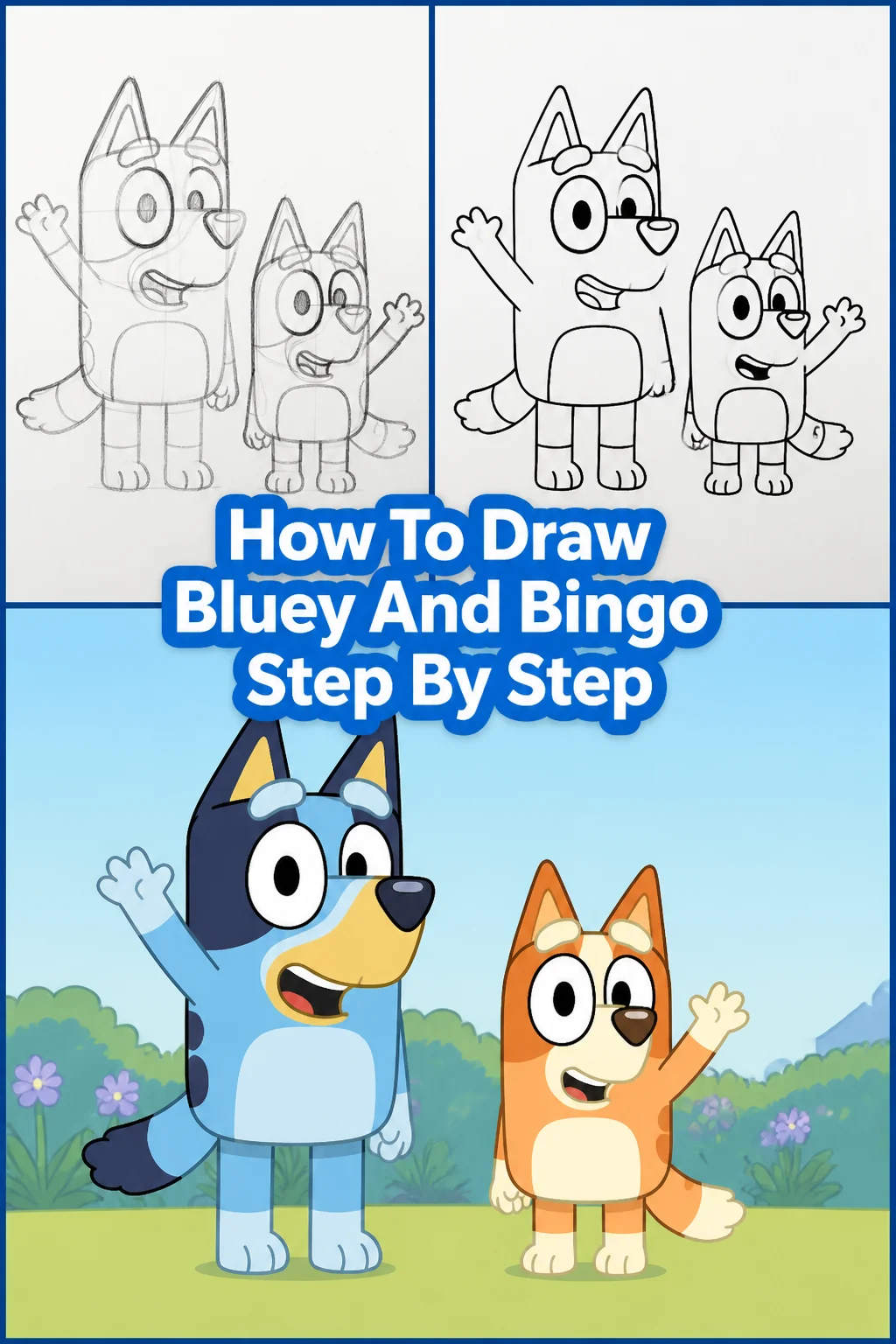
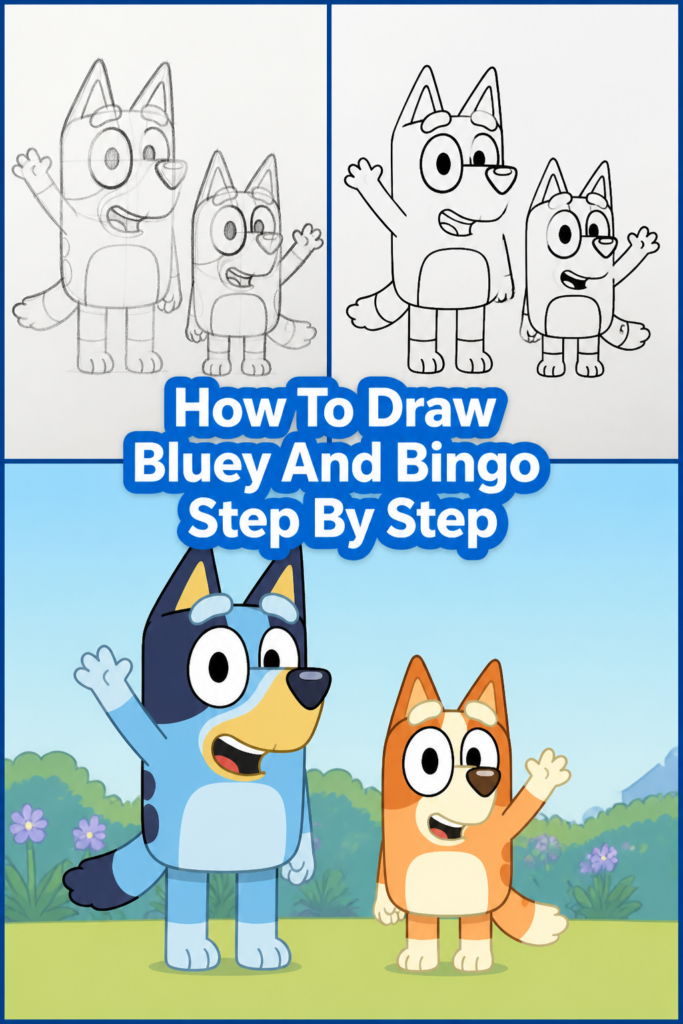
🐾 How To Draw Bluey And Bingo Step By Step
Do you ever wish you could bring the magic of Bluey and Bingo to life on paper?
I remember spending countless hours trying to sketch these beloved pups for my own kids, figuring out the best ways to capture their playful spirit.
This guide shares those easy-to-follow steps, making it simple for anyone to draw their favorite Heeler sisters.
Quick Overview
Get ready to create your own adorable Bluey and Bingo drawings!
This guide breaks down the process into simple, manageable steps, perfect for beginners.
- Time needed: 45-60 minutes (for both characters, allowing for practice)
- Difficulty: Beginner
- What you’ll need: Paper, a pencil (HB or 2B recommended), an eraser, and optional coloring supplies (crayons, colored pencils, or markers).
Step-by-Step Instructions
We’ll start by drawing Bluey, then move on to her little sister, Bingo, highlighting the small differences that make each character unique.
Step 1: Get Ready to Sketch Bluey’s Head
Start with a light oval shape in the upper center of your page.
This will be Bluey’s head. Make it a bit wider than it is tall, almost like a squashed egg.
Don’t press too hard; these are just guidelines.
Pro Tip: Use your entire arm to draw initial shapes, not just your wrist. This creates smoother, more confident lines.
Step 2: Define Bluey’s Snout and Eyes
Draw a smaller, slightly rounded rectangle or a wide ‘U’ shape for her snout, overlapping the bottom half of the head oval.
Add two small circles above the snout for her eyes. Place them slightly apart, centered on the main head shape.
Sketch a small, upside-down ‘U’ or a wide ‘V’ shape for her nose at the top of the snout.
Step 3: Add Bluey’s Ears and Cheeks
Draw two triangular shapes on top of Bluey’s head for her ears.
Make them point slightly outwards. One ear will be a bit larger or more visible than the other, depending on her pose.
Connect the snout to the main head with two subtle curved lines on each side to form her cheeks.
Step 4: Form Bluey’s Body
Sketch a large, bean-like shape underneath Bluey’s head for her body.
It should be rounder at the bottom and slightly narrower at the top where it meets the head.
Ensure it looks soft and squishy, not stiff.
Step 5: Draw Bluey’s Legs and Feet
Add four short, stubby legs extending from the bottom of her body.
Her front legs will be slightly closer together than her back legs.
Draw small, rounded rectangles or thick ‘U’ shapes for her feet at the end of each leg.
Step 6: Outline Bluey’s Tail and Facial Details
Sketch a long, curved tail that points upwards and then curls slightly at the end.
It should be thick at the base and taper to a point.
Add small, curved lines above her eyes for eyebrows and a simple smile line under her nose.
Step 7: Refine Bluey’s Outline and Add Markings
Go over your light sketch lines with a firmer hand, making your final outline.
Erase any overlapping or unnecessary guideline marks.
Draw Bluey’s characteristic spots: a few on her back, one on her head, and patches on her ears and tail.
Now, let’s move on to Bingo!
Step 8: Sketch Bingo’s Head Shape
Draw another light oval shape for Bingo’s head, similar to Bluey’s but perhaps slightly rounder or more vertically oriented.
Place it next to Bluey on your paper, or on a new sheet if you prefer.
Remember, light lines are key for easy corrections.
Step 9: Define Bingo’s Snout and Eyes
Add a slightly smaller, more rounded snout shape to the lower half of Bingo’s head.
Draw two small circles for her eyes, positioned similarly to Bluey’s.
Sketch her small, triangular nose at the top of the snout.
Step 10: Add Bingo’s Ears and Cheeks
Draw two triangular ears on top of Bingo’s head.
Notice that Bingo’s ears are often depicted a little shorter and perhaps slightly more upright than Bluey’s.
Connect the snout to the head with gentle curves for her cheeks.
Step 11: Form Bingo’s Body
Sketch a bean-like body shape for Bingo, just like Bluey’s.
It should be proportional to her head, making her look like a younger, slightly smaller version.
Keep the lines soft and flowing.
Step 12: Draw Bingo’s Legs and Feet
Add four short, sturdy legs extending from her body.
They are similar in style to Bluey’s, but perhaps a touch shorter, emphasizing her younger age.
Sketch her rounded feet at the end of each leg.
Step 13: Outline Bingo’s Tail and Facial Details
Draw Bingo’s tail. It’s often shown as a little shorter and curlier than Bluey’s, but still thick at the base and tapering.
Add her small eyebrows and a cheerful smile line beneath her nose.
Step 14: Refine Bingo’s Outline and Add Markings
Trace over your preferred lines to create a clean, solid outline for Bingo.
Erase any remaining pencil guides.
Draw Bingo’s specific markings: a large patch around one eye, a few spots on her back, and distinct patches on her ears and tail.
Step 15: Color Your Masterpiece (Optional)
Grab your coloring supplies!
Bluey is various shades of blue and light blue, with a cream belly and snout.
Bingo is orange, reddish-brown, and cream, with a cream belly and snout.
Fill in the colors carefully, paying attention to their unique patterns.
Common Mistakes to Avoid
Even experienced artists make mistakes. Knowing what to watch out for can save you time and frustration.
Disproportionate Features
One common pitfall is making the head too big or too small for the body, or vice-versa. Bluey and Bingo have very distinct proportions.
Always start with light, basic shapes for the head and body first, then add features like snouts and ears, ensuring they fit within those initial guides.
Stiff Poses
Bluey and Bingo are full of energy! A common mistake is drawing them in very rigid, symmetrical poses, which loses their playful essence.
Try to add a slight tilt to their heads or a curve to their bodies. Imagine them mid-action, even if it’s just standing.
Forgetting Guidelines
Skipping the initial light sketches for head and body shapes can lead to uneven or messy drawings later on.
These light lines are your best friends. They are meant to be erased, guiding your hand without being part of the final artwork.
Incorrect Color Placement
While both dogs are Heelers, their color patterns are very specific. Mixing up Bluey’s blue patches with Bingo’s orange ones is a frequent error.
Always double-check a reference image for their unique markings, especially around their eyes, ears, and tails, before you start coloring.
Troubleshooting
Don’t worry if your drawing isn’t perfect on the first try. These tips can help you overcome common hurdles.
“My lines look shaky.”
Shaky lines often come from drawing too slowly or with too much tension in your hand.
Try to draw with a lighter touch and use longer, more fluid strokes. Practice drawing circles and ovals repeatedly without lifting your pencil, focusing on smooth motion.
“My character looks flat.”
Flat drawings usually lack a sense of depth or dimension. Bluey and Bingo are cartoon characters, but they still have volume.
Use overlapping lines where one part of the body is in front of another (e.g., the snout over the head). A slight angle to the head or body can also add a lot of life.
“I can’t get the eyes right.”
The eyes are crucial for expressing personality. If they look off, the whole character can feel wrong.
Focus on simple, round dots for the pupils. Once those are placed, add a tiny white highlight dot in the corner of each eye. This simple addition brings them to life instantly.
Key Takeaways
- Start with basic shapes: Ovals and bean shapes form the foundation of Bluey and Bingo.
- Use light guidelines: Sketch softly first, then refine your lines.
- Observe reference images: Pay attention to their unique proportions and markings.
- Embrace imperfections: Every drawing is a step in your artistic journey.
- Practice makes progress: The more you draw, the better you’ll become.
- Have fun with it: The joy of drawing is in the process, not just the perfect outcome.
Frequently Asked Questions
Can I use a pen instead of a pencil?
While you can, starting with a pencil is highly recommended. Pencils allow you to sketch lightly, erase mistakes easily, and refine your drawing before committing to ink. Once you’re confident with your pencil sketch, you can always go over it with a pen.
How do I make them look more like the show?
The key is observation. Pay close attention to how their ears tilt, the curve of their tails, and the placement of their spots in different episodes. Practice drawing them from various angles and poses, not just head-on. Exaggerating their expressions slightly can also help.
What if my drawing doesn’t look perfect?
That’s completely normal and part of the learning process! Drawing is a skill that develops over time. Focus on enjoying the act of creating. Every drawing, no matter how it turns out, teaches you something new and helps you improve for the next one.
Is it okay to trace first?
Absolutely! Tracing can be a fantastic way to understand proportions and shapes. It builds muscle memory and helps you see how the different parts of the character fit together. Use tracing as a learning tool, then try drawing freehand afterwards.
Our Top Recommended Finds
Having the right tools can make your drawing experience even better.
- Sketchbook: A dedicated sketchbook with good quality paper prevents bleed-through and offers a clean space for all your creations.
- Drawing Pencil Set: A set with various lead hardness (e.g., 2H, HB, 2B, 4B) allows you to create light guidelines and dark, bold outlines.
- Kneaded Eraser: Unlike standard erasers, a kneaded eraser lifts graphite without damaging the paper, perfect for subtle corrections and highlights.
Your Bluey & Bingo Masterpiece Awaits!
You now have all the steps to bring Bluey and Bingo to life on your page.
The best part about drawing these characters is capturing their boundless energy and charm.
Why not grab your pencil and paper right now and start your first Bluey and Bingo drawing?